
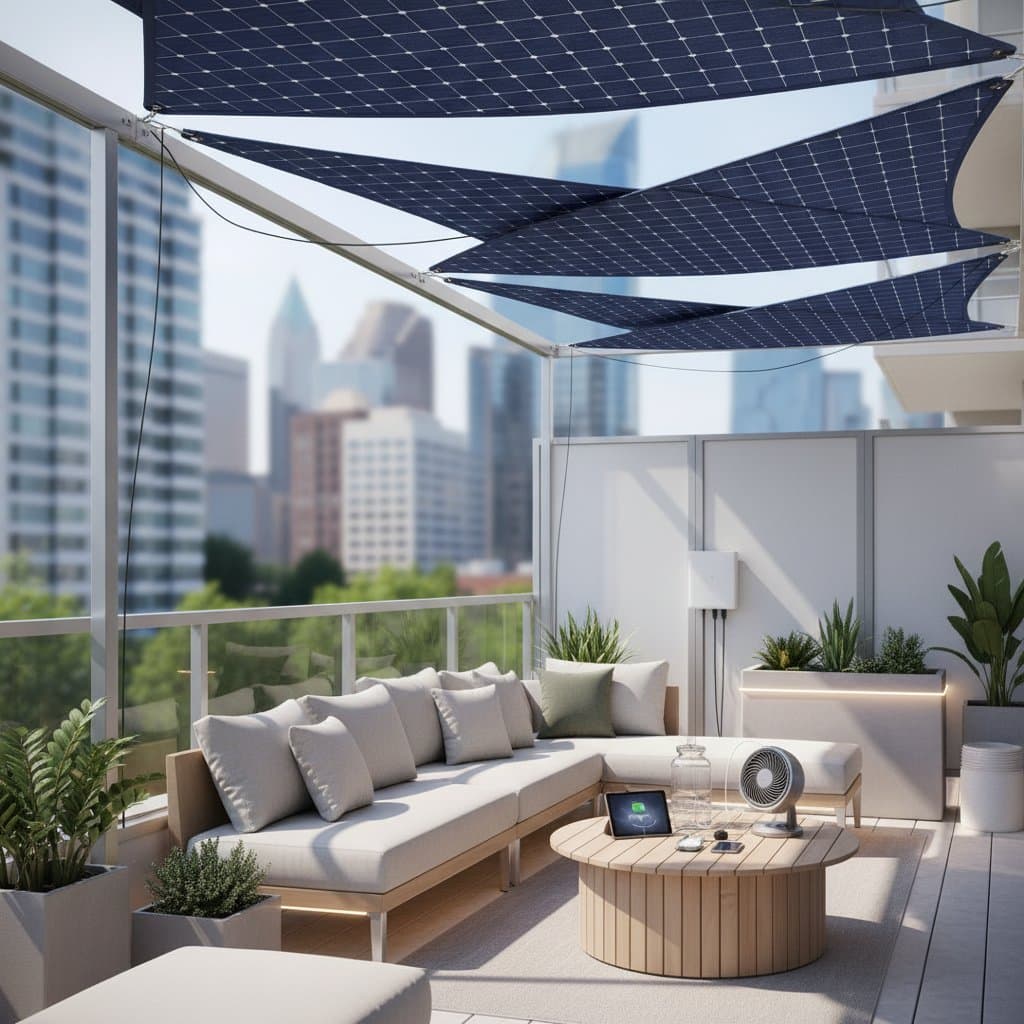
Harnessing Solar Shade Sails to Cool and Power Your Balcony
Urban balconies often face intense sunlight, turning comfortable spaces into sweltering spots during peak hours. Solar shade sails address this challenge by combining UV-blocking fabric with integrated photovoltaic technology. These innovative structures not only reduce heat but also convert sunlight into electricity to charge devices, operate fans, or illuminate evenings.
This approach suits renters and homeowners seeking flexible solar solutions without permanent installations. Readers will gain insights into the mechanics of these sails, required components for setup, and strategies for long-term reliability. By the end, you will understand realistic energy outputs and scenarios requiring expert intervention.
Understanding Solar Shade Sails
Solar shade sails consist of durable, tensioned fabric canopies embedded with thin-film solar cells. The material typically blocks 80 to 95 percent of UV rays, creating shaded areas up to 10 degrees cooler than exposed surfaces. Photovoltaic layers capture diffuse and direct sunlight, generating direct current that a controller regulates for safe storage.
Energy production varies by sail size, location, and weather. A standard 8-by-10-foot sail in a sunny urban setting might yield 50 to 100 watts per hour on clear days. This power suffices for low-demand items like LED lights or phone chargers, promoting self-sufficiency in compact outdoor areas.
These sails enhance aesthetics, mimicking modern sails or awnings while supporting sustainability goals. They install temporarily, avoiding structural modifications that could violate lease terms or building codes.
Essential Tools and Materials
Selecting the right components ensures a stable, efficient system. Begin by evaluating your balcony's dimensions and sun exposure patterns to choose appropriately sized elements.
Key materials include:
- A solar shade sail measuring 8 by 10 feet, featuring monocrystalline or flexible solar panels rated at 50 to 80 watts.
- Mounting hardware such as eye bolts, turnbuckles, and UV-resistant tension cords to secure corners at 45-degree angles.
- A 12-volt charge controller with overcharge protection to manage power flow and prevent battery damage.
- A rechargeable battery pack, ideally lithium-ion with 20 to 50 ampere-hour capacity, equipped for solar input.
- Weatherproof extension cables, MC4 connectors, and junction boxes for reliable electrical links.
- Stainless steel carabiners or D-rings for tool-free attachment and detachment.
Recommended tools:
- A 25-foot measuring tape to plot anchor points precisely.
- Cordless drill paired with carbide-tipped bits for masonry surfaces like concrete railings.
- Combination wrench set and Phillips screwdriver for tightening fittings.
- Sturdy extension ladder supporting at least 250 pounds, with non-slip feet.
- Digital multimeter to verify voltage and continuity during assembly.
Prioritize corrosion-resistant items for longevity in humid or coastal environments. Gloves provide grip and protect against sharp edges, while safety glasses shield eyes from debris.
Step-by-Step Installation Guide
Proper installation maximizes shade coverage and energy capture. Allocate a full afternoon, working with a partner for stability on elevated surfaces.
First, identify four anchor points: two high on walls or railings and two lower on posts or floors, forming a trapezoid shape. Measure distances to ensure even tension, aiming for 20 to 30 percent sag in the center to shed water. Mark locations with chalk, avoiding gas lines or unstable fixtures.
Drill pilot holes using a low-speed setting to minimize cracking in brick or concrete. Insert expansion anchors, then attach eye bolts or brackets, torquing to manufacturer specifications. Connect the sail's corners to hardware via carabiners, pulling cords gradually with turnbuckles until taut but flexible.
Wire the solar panels to the charge controller following polarity markings: positive to positive, negative to negative. Link the controller output to the battery, then test with the multimeter for 12 to 14 volts under sunlight. Attach devices via USB ports or DC outlets on the battery pack.
Seal all penetrations with silicone caulk to prevent moisture ingress. Initial testing involves monitoring output for 24 hours to confirm consistent performance.
Prioritizing Safety
Safety forms the foundation of any balcony project, especially with electrical components exposed to elements. Adhere to guidelines to mitigate risks of shocks, falls, or structural failures.
Disconnect all power sources before handling wires or controllers. Maintain dry conditions during connections, using insulated tools and GFCI-protected outlets if extending to indoor power. Position the sail at least 10 feet from overhead power lines or conductive structures like satellite dishes.
Assess battery limits strictly; a 20-amp-hour unit supports up to 240 watt-hours daily without overload. Monitor for heat buildup, ensuring ventilation around the controller. In winds exceeding 25 miles per hour or during severe weather, dismantle the setup promptly to avoid fabric rips or anchor pullouts.
For integrations with home electrical systems, consult a certified electrician. They verify compliance with local codes, such as NEC standards for outdoor low-voltage wiring.
Ongoing Maintenance Practices
Regular upkeep extends the lifespan of solar shade sails to 7 to 12 years, preserving both shading and power generation efficiency.
Conduct monthly cleanings by gently wiping solar surfaces with a microfiber cloth dampened in distilled water and mild soap. Avoid pressure washing, which can dislodge cells. Biannual inspections involve checking tension cords for fraying and anchors for corrosion, retightening as needed with a torque wrench.
After high-pollen periods or dust storms, hose down the fabric lightly from below to remove residues without soaking electronics. For storage, deflate the sail, fold along seams, and place in a ventilated container away from direct sun.
Track performance with a simple log: note daily watt-hours and battery levels. If output drops below 80 percent of rated capacity, inspect for shading from nearby plants or dirt accumulation.
Cost Analysis and Value
Investing in a solar shade sail delivers quick returns through energy savings and comfort gains. Basic kits range from $200 to $450, scaling with panel efficiency and fabric quality.
Additional expenses cover hardware at $40 to $60 and batteries from $70 to $120. Total outlay for a starter system falls under $600, far below rigid panel arrays that exceed $1,000 plus permits.
Installation demands 3 to 5 hours, depending on surface types. Over five years, the setup offsets costs by powering gadgets that would otherwise draw from the grid, potentially saving $50 to $100 annually in urban electricity rates.
Flexibility adds value: relocate or sell the system easily, unlike fixed installations. Consider warranties covering 5 to 10 years on panels and 3 years on fabric.
Scenarios Requiring Professional Assistance
While DIY suits most balcony projects, certain complexities demand expert skills to ensure safety and optimization.
Engage a specialist for wall penetrations or conduit runs, where improper sealing risks water damage. Similarly, attachments to steel beams or heights over 10 feet require engineering assessments to handle wind loads.
For multi-sail arrays feeding a central inverter or grid connection, professionals calculate wiring gauges to minimize voltage loss. They also perform load testing with advanced meters, confirming the system handles peak draws like a 50-watt fan without fluctuations.
Request evaluations of grounding integrity and IP-rated enclosures for waterproofing. Such interventions prevent costly errors and may qualify for rebates in solar-friendly regions.
Steps to Launch Your Solar Shade Sail Project
Transition from planning to execution with these targeted actions.
- Survey your balcony over several days, recording peak sun hours and shading from buildings to select an optimal sail orientation.
- Research kits from reputable suppliers, prioritizing those with at least 20 percent efficiency ratings and user reviews on ease of assembly.
- Sketch anchor configurations on graph paper, factoring in 2-foot clearances from edges to distribute weight evenly.
Follow with a trial dry-run on the ground to familiarize yourself with connections. This preparation minimizes on-site adjustments.
Realizing Benefits in Daily Use
A well-implemented solar shade sail transforms balconies into versatile retreats. Shaded zones invite longer relaxation, while generated power sustains ambient lighting for evening gatherings or charges devices during blackouts.
This integration fosters environmental stewardship, reducing reliance on fossil fuels in dense cities. The minimal footprint aligns with modern living, delivering tangible rewards in comfort and independence with straightforward effort.